Please log in, or sign up for a new account and purchase a subscription to continue reading.
We have used your information to see if you have a subscription with us, but did not find one. Please use the button below to verify an existing account or to purchase a new subscription.
Your current subscription does not provide access to this content. Please use the button below to manage your account.
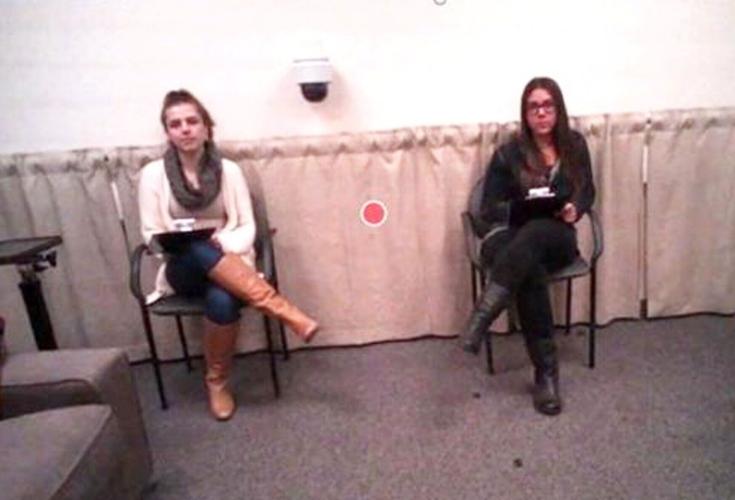
A visual from the study: The red circle shows where the participant is looking at that moment. The judge on the left is the positive judge, while the judge on the right is the potentially critical judge. (Kristy Allen via SWNS)
who avoid potentially negative feedback are prone to higher anxiety, suggests a new study.
The findings run counter to prevailing wisdom in the field, say American psychologists.
To better understand anxiety, a research team studied 90 in sessions spanning three years, using wearable eye-tracking glasses as the subjects gave a speech to two "judges".
One of the judges responded positively, while the other responded potentially negatively by maintaining a neutral facial expression, occasionally looked around the room, and shifting in their seat.
The findings showed that who avoided looking at the potentially negative feedback during their speeches reported the most anxiety three years later, even accounting for their initial level of anxiety.
Study author Dr Kristy Allen said: “When we think about what puts kids at risk for anxiety, one of the things we look at is how they pay attention to the world around them.
“Past research suggests that adults who focus on things in their environment that seem more threatening may be at greater risk.
"For example, in a crowd of people, if one person has a negative or angry expression, or even an ambiguous expression you can’t quite read, some individuals will focus more on that face than others.
A visual from the study: The red circle shows where the participant is looking at that moment. The judge on the left is the positive judge, while the judge on the right is the potentially critical judge. (Kristy Allen via SWNS)
By Talker
"There’s evidence suggesting that adults who habitually focus on overtly negative or potentially negative cues may be more likely to develop heightened levels of anxiety.
"The literature is decidedly more mixed in youth, however, which this study tried to better understand.�
Dr Allen, Assistant Professor of clinical child psychology at the , said the idea is called “attention bias.�
She said: "In other words, it’s a slant in how you direct your focus across environments.
“That was the background for this particular study.
“But interestingly, we found almost the opposite of what is commonly seen in adults.
"Specifically, adolescent girls who avoided potentially threatening information, both immediately at the start of the task and across the two minutes, showed the greatest increase in anxiety symptoms over time.�
Dr. Allen says girls are thought to be particularly sensitive to social feedback, which could contribute to the onset of anxiety disorders in adolescence.
The new study, published in the , focused on girls, who by the third year of the study were aged 13 to 15.
Dr. Allen said: “For this particular paper, we focused on what we call the ‘attention task.’
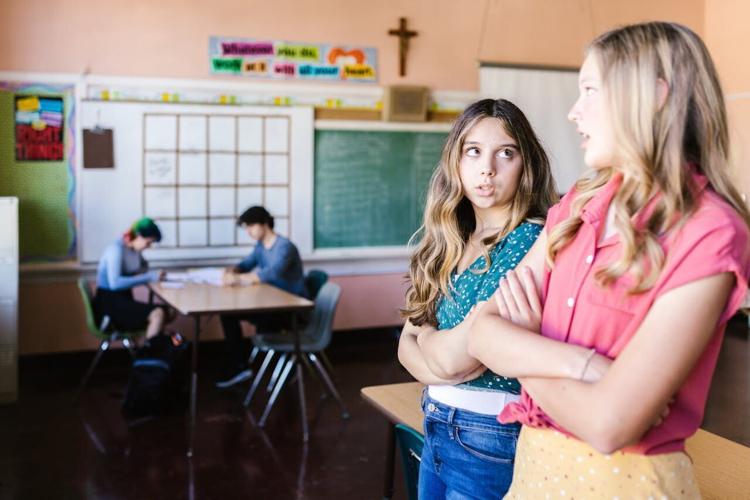
(Photo by Yan Krukau via Pexels)
“We tell participants to imagine they’re auditioning for a reality TV show for kids, and they need to convince us why we should choose them for the show.
"We only give them two minutes to prepare a two-minute speech, which is intentional - it’s hard to prepare under that kind of time pressure.
"The goal is to make it a somewhat stressful situation so we can observe how it impacts where they direct their attention.�
The two “judges� listened to the participants’ speeches, but the participants didn’t know that the judges were trained ahead of time to behave in specific ways.
Dr. Allen said one judge was the “positive judge� following a set of instructions so that every 10 seconds, they did something non-verbal but encouraging - such as smiling, nodding, or giving warm, positive feedback.
The second judge was the “potentially critical judge� and maintained a neutral expression the whole time.
Dr. Allen said: “Not smiling, not frowning, not looking disgusted, just flat.
“But in a stressful situation like giving a speech, even neutrality can feel negative or critical.�
She says most research in this field is based on youth responses to static images presented via computerised tasks.
Dr. Allen and her team sought to create a "real-world" situation that more closely mimics what attention bias might look like in a .
She says mobile eye-tracking glasses enable such innovation.
Dr. Allen said: “A big focus of my research is looking at the intergenerational transmission of anxiety - really trying to understand why anxiety tends to cluster in families.
(Photo by RDNE Stock project via Pexels)
By Talker
“While genetics are certainly important, environmental factors actually account for more of this effect.�
She is now analysing the eye-tracking data of mothers as they observed their daughters’ speeches to the judges, drawn from the same experimental data.
Dr. Allen said: “We had mothers in the room with their adolescent daughters.
“The mums also wore eye-tracking glasses so we could monitor how they attended to potential threats and how that attention might shape their interactions with their child.
"The mothers actually helped their for the task.
"Our hypothesis is that mums who are more vigilant to threat may approach stressful situations in ways that make them even more stressful for their child.
"For example, they might try to take over the task rather than giving their child the autonomy to work through it themselves.�
She hopes next to bring fathers into the research.
Dr. Allen added: “I’ve got a different set of hardware, but similar eye-tracking glasses, and the goal is to understand the unique role of dads.
“We know anxiety can flow through the paternal side as well, and I want to better understand how these attention biases in parents shape outcomes for the next generation.�
Keep it Clean. Please avoid obscene, vulgar, lewd,
racist or sexually-oriented language. PLEASE TURN OFF YOUR CAPS LOCK. Don't Threaten. Threats of harming another
person will not be tolerated. Be Truthful. Don't knowingly lie about anyone
or anything. Be Nice. No racism, sexism or any sort of -ism
that is degrading to another person. Be Proactive. Use the 'Report' link on
each comment to let us know of abusive posts. Share with Us. We'd love to hear eyewitness
accounts, the history behind an article.








(0) comments
Welcome to the discussion.
Log In
Keep it Clean. Please avoid obscene, vulgar, lewd, racist or sexually-oriented language.
PLEASE TURN OFF YOUR CAPS LOCK.
Don't Threaten. Threats of harming another person will not be tolerated.
Be Truthful. Don't knowingly lie about anyone or anything.
Be Nice. No racism, sexism or any sort of -ism that is degrading to another person.
Be Proactive. Use the 'Report' link on each comment to let us know of abusive posts.
Share with Us. We'd love to hear eyewitness accounts, the history behind an article.