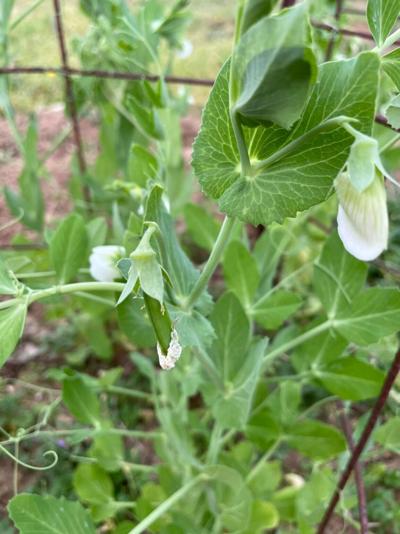
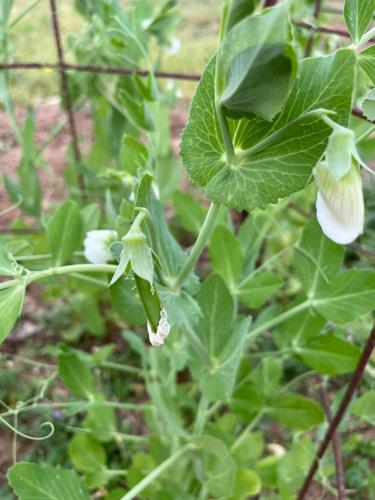
Since we can see a light at the end of the tunnel, now is the time to start getting all your supplies and seeds ready for the garden. The last week of February is an ideal time to plant onions, kale, and my favorite – peas. Peas prefer cooler temperatures and will normally die off by June when the temperatures start hitting 80. When the peas die off, you would have the perfect amount of time to plant bush beans right back in the same spot. They prefer to be directly seeded into the ground as opposed to being transplanted. Since many of them have vining tendencies, they can tangle up quickly in the small cell packs. Peas can be planted tight in rows and can be sown 2� apart.
There are three main types of green peas: snow, snap, and shelling. Make sure you purchase the one that is best for your situation. Snap peas have edible pods with small peas inside. Snow peas have flat pods and shelling peas form large peas and need to be shelled after harvesting. Be sure to also note if they are dwarf types or the type that will need some type of trellis to run up.
Snap peas are probably my favorite of the three types. Make sure to harvest them when they are smaller or they will form a string, just like green beans. They’re also a great vegetable to get our kids hooked onto gardening. There are numerous cultivars of snap peas, but good choices all seem to have sugar in the name. Look for cultivars like ‘Sugar Sprint’, ‘Sugar Snap’, and ‘Sugar Ann’. Snow peas are an excellent addition to the spring stir-fry menu. If you want to experiment with snow peas this year, try ‘Avalanche’ or ‘Oregon Giant’. Shelling peas have a tough exterior and they need to be shelled, thus the name. Most cultivars will yield between 7-10 peas per pod when they are mature. Good selections of shelling peas include ‘Early Alaska’, ‘Strike’, or ‘Wando’.
If you have any questions regarding horticultural matter in your garden or lawn, feel free to contact Lucas Holman, Horticulture UT-TSU Extension Agent, Wilson County at 615-444-9584 or Lholman1@utk.edu.
The University of Tennessee Extension offers its programs to all eligible persons regardless of race, color, national origin, sex, age, or disability and is an Equal Opportunity Employer. Through its mission of research, teaching and extension, the University of Tennessee Institute of Agriculture touches lives and provides Real. Life. Solutions.




(0) comments
Welcome to the discussion.
Log In
Keep it Clean. Please avoid obscene, vulgar, lewd, racist or sexually-oriented language.
PLEASE TURN OFF YOUR CAPS LOCK.
Don't Threaten. Threats of harming another person will not be tolerated.
Be Truthful. Don't knowingly lie about anyone or anything.
Be Nice. No racism, sexism or any sort of -ism that is degrading to another person.
Be Proactive. Use the 'Report' link on each comment to let us know of abusive posts.
Share with Us. We'd love to hear eyewitness accounts, the history behind an article.